
Welcome to our series of interviews presenting our talented board candidates. These interviews give you a unique opportunity to get to know our talented board candidates, who are ready to bring their expertise and insight to the boardroom.
We have handpicked a selection of experienced leaders with a broad range of backgrounds and expertise. They represent a diversity of perspectives, and all share an understanding of the importance of good governance in achieving strategic and operational goals.
Through these interviews you will gain insight into what motivates them, their views on board work and, not least, the personal qualities and skills they can offer. We hope this will give a fuller picture of each candidate and inspire engagement and discussion about the role of the board in modern business management.
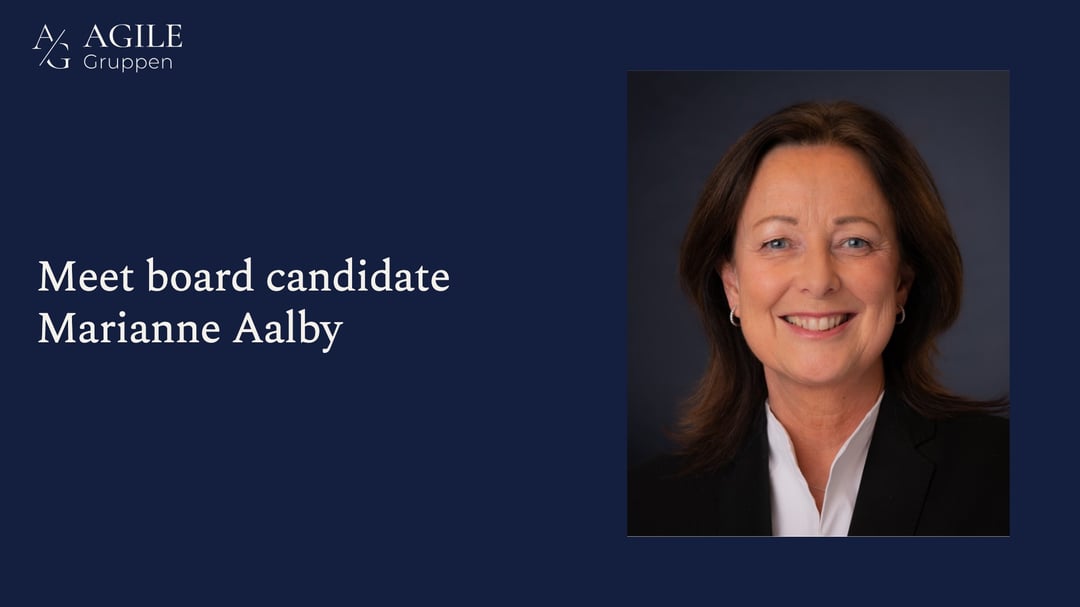
This time we talk to Marianne Aalby
Marianne holds an MSc in business, is an authorised financial analyst and is an experienced leader with extensive board experience.
Since sitting on the board of the World Trade Center in Dallas as a newly qualified credit analyst at JP Morgan Chase, Marianne has held many board positions in banking/finance, real estate and industry. She has served on the boards of OBOS Boligkreditt and OBOS Factoring, and has been chair and board member of 15 companies on behalf of Formue and its clients. For the past two years she has chaired 12 property companies owned by real estate funds, in her capacity as CFO of Attivo AS. She also previously sat on the portfolio committee of Forening for Finansfag for fifteen years. Today Marianne holds several board positions within the structure of Søderberg & Partners Wealth Management.
What motivates you to serve on a board?
Being able to contribute to value creation, to take the company further in its development and to help it achieve its strategic goals are the aspects of board work that I find particularly rewarding. Shared learning and the sharing of expertise in the boardroom are also something I value highly.
What are the most important qualities of a good board candidate?
A well-functioning, value-creating board consists of a chair and members who are skilled in their respective fields, are curious and good listeners, come to meetings prepared and engaged, and are good at understanding people. Experienced board members hear what is said and what is left unsaid in the boardroom, and are at the same time able to prioritise matters and issues without becoming operational.
What is your philosophy on board work?
Good board work is the result of collaboration and careful planning. It is important that the board is aware of its responsibility to look after all stakeholders. A successful organisation takes care of its employees, who in turn take care of customers and the environment. All companies face ever clearer requirements to take responsibility for their climate impact, the effects of climate change, their social responsibility and sustainable business models. This is central to board work, and it has a major impact on the company’s operating conditions and profitability.
A good board sets the premises and clear operating conditions, through targets such as KPIs that are followed up, so that management has predictability and a mandate to deliver on the company’s strategy. As I see it, boards that work too operationally miss their role and do not help lift the company.
The board’s understanding of its role in a changing society and a changing market, and how it handles this, is also important for its ability to create value. The right expertise is important, both specialist expertise in innovation and technology and continuous skills development for the board as a collective. The board must understand where the company is today, where it is going and how it will get there – together.
Another critical success factor for an effective board is that the work is planned and structured throughout the year, and that board papers are orderly and capture what matters to the company. The chair has an important role in maintaining an effective way of working and in ensuring that the board has enough time on its own to work on strategy and self-evaluation.
How would you like people to describe you after a board meeting?
My aim is to be a good, competent team player with an open mind. I want to be seen as an active contributor with a grasp of the whole, who asks relevant questions and ensures risk management and the evaluation of opportunities, and who actively helps the company achieve a good risk-adjusted return within socially responsible and sustainable parameters.
What is the most valuable lesson you have taken from your previous board experience?
A skilled chair can make the difference between a company succeeding or not. Although board members share collective responsibility, it is the chair who has ultimate responsibility and who should have the closest dialogue with the company’s management. The chair largely sets the agenda for the board’s work and is responsible for maintaining a good, value-creating way of working.
What do you hope to contribute as a board member?
I am known for being well prepared, curious, interested and engaged. At the same time, I am strategic and forward-looking and have a lot of positive energy. My broad experience and expertise from several industries and many years of board experience give me a solid toolbox that I use in all my work. Together with my board colleagues, I will seek to develop the company we lead for the benefit of all its stakeholders.
Do you need new board members? Get in touch!



